
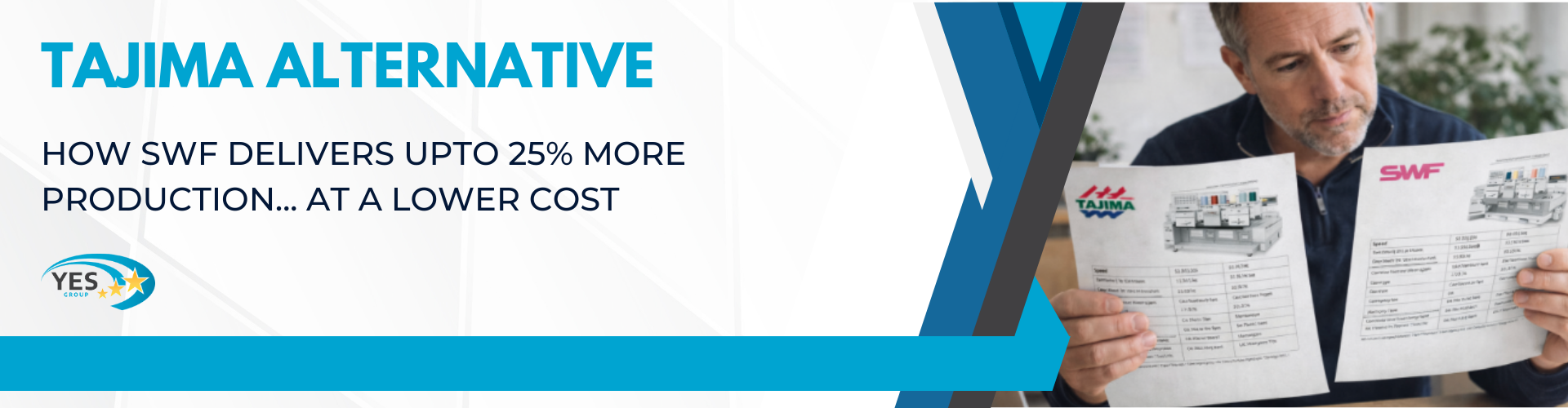
Tajima embroidery machines are often one of the first names UK embroidery businesses come across when they start researching commercial equipment.
The brand has a strong reputation for precision and reliability, but for many growing shops the conversation quickly turns to price, lead times, servicing, and long-term running costs.
This guide covers what UK buyers should consider before investing in a Tajima machine, and why an increasing number of businesses are comparing Tajima with proven alternatives that offer strong productivity and more accessible local support.
And it will introduce you to a Korean manufacturer with over three decades of innovation behind them… and strong UK roots as well.
Tajima has earned its reputation for precision and consistency. But in the UK, most buying decisions come down to practical questions:
How quickly can the machine be delivered, installed, and supported?
What does servicing look like once it’s on the floor and in daily production?
How flexible is it when your job mix changes week to week?
What is the real cost of ownership once downtime, training, and operator efficiency are included?
If you are comparing Tajima models, it’s worth measuring alternatives on those same points, not just brand reputation.


SWF’s (S. Korean manufacturer) standout advantage is not a small technical tweak. It is a practical rethink of how embroidery shops actually run day to day. Their patented dual-function technology allows a multi-head machine to be split into two independent working zones, so you are not forced to run every head in the same way, all the time.
Instead of the machine dictating your workflow, the workflow adapts to the jobs coming through the door.
In plain terms, it lets you run two different types of work at the same time, without constantly stopping to change setups.
Run garments on one side while stitching caps or different products on the other
Keep production moving even if one side pauses for thread breaks or routine checks
Switch between completely different job types without lengthy setup changes
Increase overall output by up to 20–25% compared to traditional single-function machines
This is not theory. It is proven technology already helping embroidery businesses improve throughput while reducing wasted time and downtime.
While Tajima machines typically offer a 439mm × 279mm embroidery field, SWF provides up to 500mm × 400mm of usable workspace. This might seem like a small technical difference, but it leads to significant business advantages:
SWF machines are built for today’s production environments, not just long-established workflows.
Large 10.4″ to 15.1″ colour touchscreens that are easy to read and navigate
Wi-Fi connectivity for wireless design transfers and live machine monitoring
Ability to connect large machine fleets to a single PC for scalable operations
Clear, intuitive menus that reduce training time and operator mistakes
For growing shops, this translates into smoother onboarding and more consistent results across operators.
SWF’s KX Series Smart Tension System focuses on consistency rather than complexity.
Continuously analyses stitch type, stitch length, and running speed
Automatically adjusts thread tension to suit the job in real time
Smart Action Presser Foot adapts to varying fabric thicknesses
Helps less experienced operators achieve reliable quality with less manual input
The result is fewer interruptions, cleaner finishes, and more predictable production across different materials.
Stitch speed matters, but it’s only one part of real production output. Thread breaks, changeovers, hooping time, and how often a machine needs attention can have a bigger impact across a full week.
SWF KX Series: up to 1,200 stitches per minute
Tajima TMEZ-KC: up to 1,100 stitches per minute
tajima post
Where SWF can pull ahead for many shops is throughput, because dual-function capability can reduce changeover time and keep more heads producing when jobs vary.
Watch a side-by-side example of a traditional multi-head workflow compared with a dual-function setup.
Exceptional Warranty Coverage
Cost-Effective Excellence
SWF machines typically cost 20–30% less than comparable Tajima models while often exceeding their capabilities. This isn’t about cutting corners — it’s about efficient engineering and competitive positioning.


T
SWF is a strong fit when your workload is varied and you need flexibility without slowing production:
Embroidery and workwear shops running mixed orders (caps, polos, outerwear) throughout the day
Contract embroiderers juggling multiple client standards and quick turnarounds
Promotional product businesses where order sizes vary and changeovers are frequent
tajima post
If most of your work is long-run, single-product production with minimal changeovers, your priorities may be different, and that is where brand choice becomes more model-specific.
The embroidery industry is evolving toward greater flexibility, efficiency, and technological integration. SWF’s approach addresses these trends directly:
Before choosing any embroidery machine, consider:
If you answered ‘yes’ to these questions, SWF deserves serious consideration.
SWF isn’t trying to be a cheaper alternative to established brands — they’re innovating in ways that meet the demands of modern embroidery. The combination of dual-function technology, larger embroidery fields, superior digital interfaces, and strong overall value positions SWF machines as a compelling choice for commercial businesses.
The question isn’t whether SWF machines can compete with traditional options — it’s whether traditional options can keep up with SWF’s innovation.
For businesses ready to embrace the future of embroidery production, SWF offers a practical, tested path forward. The technology is proven, the value is exceptional, and the results speak for themselves.
Ready to experience the SWF advantage? Contact YES Group today to schedule a demonstration and see how SWF’s innovative technology can transform your embroidery business. With over 28 years of industry experience and comprehensive support, YES Group ensures you get the most from your SWF investment.
learn more about SWF multihead embroidery machines.