
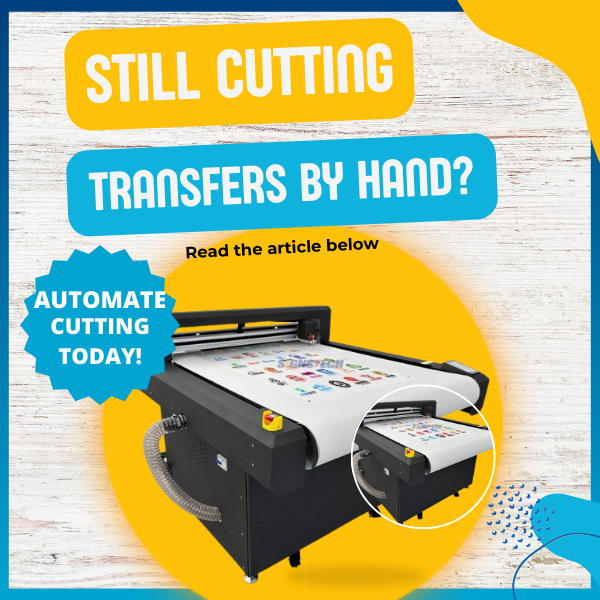
For many DTF print businesses, the cutting process is the last part of the workflow still stuck in the manual world.
You’ve got an efficient printer and a built in powder and curing system—but you’re still cutting transfers off of that finished roll by hand with scissors, rotary blades, or craft knives.
And yes, DTF printing relieves you of having to actually weed the transfer, but when you’re trying to maximise the number of images you can fit on your film there’s still quite a bit of cutting to be done.
Especially as your order volume grows.
Manual cutting may be familiar, but it’s slow, inconsistent, and difficult to scale. In contrast, automated cutting systems offer faster turnaround, cleaner results, and a better return on time and labour.
So how do you know when it’s time to make the switch?
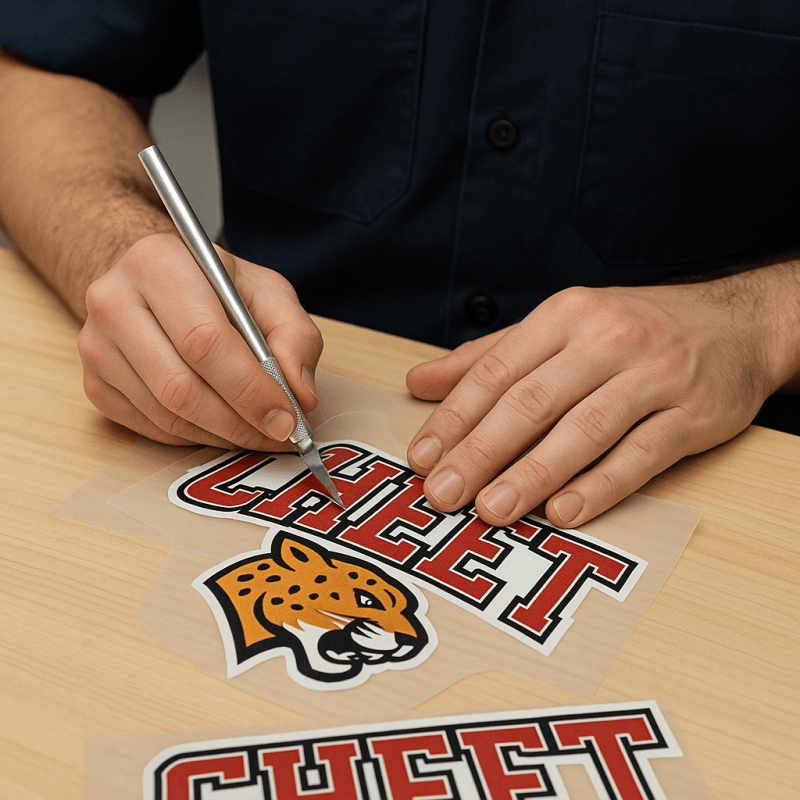
One good way to see if automated DTF transfer cutting will make sense for your business is to actually do the math.
Time how long it takes to prep the transfers for application after they’re printed.
Start your timer when you remove the roll from your DTF printer. Stop it when all of the individual transfers have been cut and separated.
Multiply that time by your labour cost per hour… then double that. You’re doubling it because the same time could be used to do something more productive, so there’s an opportunity cost attached to the entire process.
Material waste:
Manual cutting usually leads to more mistakes — slips of the knife, uneven edges, damaged transfers. If you regularly have to reprint jobs because of cutting errors, factor in the cost of wasted film and ink as well.
Labour bottlenecks:
When your staff is stuck cutting transfers by hand, you’re creating a bottleneck. Jobs pile up, deadlines get tighter, and the risk of overtime (or rush shipping) costs increases. Add a realistic buffer for that extra cost when doing your calculations.
Risk of injury:
While this is typically a risk only for the busiest shops, using any manual cutting device for extended periods can cause repetitive strain injuries like carpal tunnel syndrome. While harder to quantify upfront, an injured employee means lost productivity, potential healthcare claims, and additional training costs for replacements.
Customer impact:
Slower turnaround times because of manual prep can mean slower deliveries to customers — or missing out on last-minute, high-profit jobs you could otherwise accept. Consider what even one or two lost orders a month might cost your business over the course of a year.
Equipment ROI:
Compare the total annual cost of manual cutting to the monthly finance payment or lease cost of an automated cutter. In many cases, a properly utilised automated cutter can pay for itself within a few months — and continue saving you money for years afterward.
Let’s say it takes you 45 minutes to manually cut a batch of printed transfers from a full roll.
Your labour cost (including wages, taxes, insurance) is £15 per hour.
First, calculate the direct labour cost:
45 minutes ÷ 60 = 0.75 hours
0.75 × £15 = £11.25
Now, account for the opportunity cost by doubling it:
£11.25 × 2 = £22.50 per batch
If you’re producing just 5 rolls per week, that’s:
5 × £22.50 = £112.50 per week
Over a year (assuming 50 working weeks):
£112.50 × 50 = £5,625
That’s £5,625 a year just in hidden labour costs for manual cutting — not including wasted materials, slower delivery times, or missed orders.
When you compare that to the cost of of the YES QuickCut DTF Transfer Cutter, for example you’ll not only pay for the equipment in just over 1 year, you’ll gain that £5,625 a year worth of effort you can expend in growing your business!
If you’re handling more than 100 transfers a day, or if your team is spending more than 1–2 hours on cutting tasks, the return on investment comes quickly.
While these tools might be fine for a few transfers a day, they simply don’t scale.
As order volume increases, manual cutting becomes a production bottleneck:
In short, the more successful your shop becomes, the more manual cutting holds you back.
Here’s how most shops are handling DTF transfer cutting today:
Basic and reliable—but slow, tiring, and prone to uneven edges
Slightly quicker, but still demand manual accuracy and constant alignment.
Useful for detail work, but unforgiving. One slip and the transfer is ruined.
Great for square corners—less helpful for logos, curves, or close-packed designs.
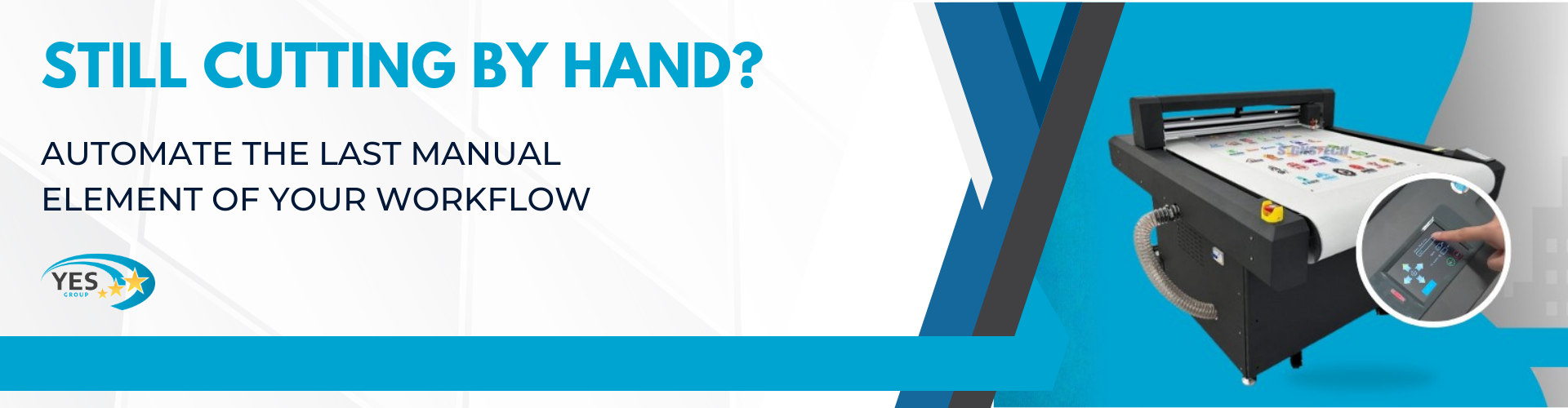
An automated solution like the YES Quick Cut DTF Roll Transfer Cutter Flatbed Cutter is built for exactly this point in your business. It removes the risk, repetition, and time drain from your cutting process.
Cuts two transfers at once, doubling productivity.
Detects printed registration marks for precise, automated contour cutting—no need to manually line anything up.
Keeps film flat and stable during cutting, eliminating slips and misalignment.
Designed to sit inline with your high-volume DTF printer, so jobs move through production without manual handling.
This isn’t just faster—it’s more accurate, more consistent, and scalable as your shop grows.
The YES Quick Cut DTF Cutter is purpose-built for the stage you’re at. It frees your team to focus on fulfilment, expands your daily capacity, and takes the guesswork out of getting clean, perfect cuts—every time.