
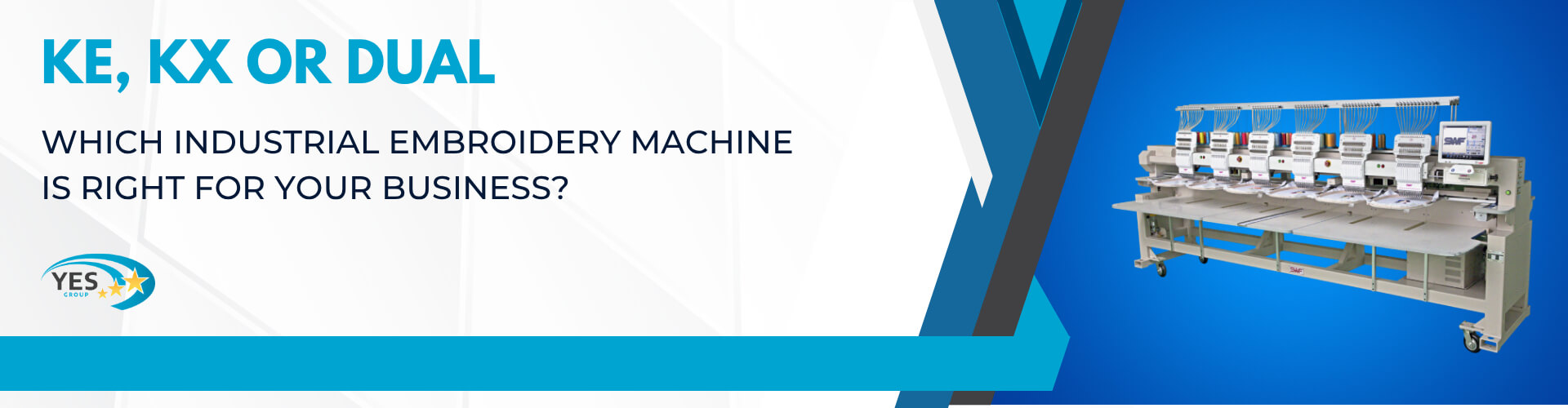
If you’re reading this, you probably have one important question:
Which industrial embroidery machine is right for my business?
That’s a great question. If you’ve already done some research, you’ll know there are several factors to consider when choosing a commercial embroidery machine.
However, I believe the decision starts with three simple questions:
Each of these questions leads to a different answer.
If you would prefer to talk it through, call YES Group on 01623 863343 or contact our embroidery specialists for honest advice based on your workload, products and plans for growth.
If your main priority is price, you’re not alone. Every business has a budget and the machine still needs to make commercial sense.
Leading embroidery machine manufacturers such as SWF Korea, Tajima, Barudan and Happy all offer machines designed to work straight out of the box, so to speak. However, the question shouldn’t only be:
“How much does the embroidery machine cost?”
It should also be:
“How much could this machine help me produce and earn?”
There are always compromises that can be made during the manufacturing and development of an industrial embroidery machine. Where the machine is manufactured, the materials used, its weight, its components and its embroidery area can all affect both the price and its long-term performance.
SWF embroidery machines are designed and manufactured in South Korea, one of the world’s leading centres for electronics, engineering and automotive manufacturing.
For me, machine construction matters. An industrial embroidery machine must contain enough steel and structural strength to remain stable during production. Excessive vibration can affect performance, stitch quality and the machine’s working life.
The embroidery area is also important. Some compact embroidery machines reduce the available stitching area to lower manufacturing costs or achieve a smaller footprint. That may be fine for the work you produce today, but what happens when a customer asks for something larger?
If you can embroider bigger products, you can accept a wider variety of work. That gives you another opportunity to earn money that a competitor with a smaller machine may have to turn away.
SWF has also proved its durability in the real world. The first SWF machine installed in the UK in 1996 is still in production today. We often describe them as “bomb-proof”, and there is a good reason for that.
You then need to decide how confident you feel about the company supplying the machine.
That part is easy to research. Look at its history, speak to existing customers and read its independent online reviews.
For businesses that want dependable multi-head production without paying for every advanced feature, I would look at the SWF KE Series multi-head embroidery machine.
It does exactly what it says on the tin: reliable, repeatable commercial embroidery production at an excellent cost per head.
If de-skilling is important to you, there is usually a reason.
Perhaps your operator is constantly adjusting the machine. Maybe you cannot get enough work through production. You may be struggling to recruit experienced embroidery operators, or you simply want to produce more with fewer interruptions.
An advanced automatic embroidery machine can help.
Different manufacturers have taken different approaches to automatic tensioning and production control. In my opinion, SWF Korea and Tajima are two of the manufacturers that stand out in this area.
But what does automatic tensioning actually mean?
To put it simply, if the embroidery machine is automatically controlling the thread tension, it should require less operator adjustment. If the operator still has to enter and continually change settings through a computer, I would question how automatic the process really is.
Automatic tensioning can help produce more consistent thread tension and stitch quality across different designs and garments. It reduces the reliance on an operator making manual adjustments at every stage.
The SWF KX Series combines smart tensioning with a range of advanced production features.
The slim cylinder arm makes it easier to access tighter products such as breast pockets, sleeves, trouser pockets and smaller tubular items.
The digitally controlled presser feet also give the operator greater control over the fabric. This can help reduce flagging and improve embroidery across different fabric thicknesses, including multilayered garments and foam used for 3D embroidery.
Then there is speed.
On a standard 7,500-stitch design, a machine running at 1,000 stitches per minute has a theoretical stitching time of seven and a half minutes. At 1,200 stitches per minute, that falls to six minutes and fifteen seconds.
That is a saving of one minute and fifteen seconds on every production run, before accounting for loading, trimming, thread breaks and garment changes. The exact real-world result will always depend on the design, fabric and machine settings, but over a full working day those time savings can quickly add up.
In theory, five machines producing 20% more could provide the output of six standard machines. That could mean avoiding the cost, floor space and staffing requirements of an additional machine.
That’s a win in my book.
This would be my favourite option.
When I buy something for a business, I don’t look at the price first. I ask:
“How will this benefit the business?”
When YES Group invested in a new software system, we wrote down everything we needed and everything we would like it to do. We then compared the costs against the improvements in productivity, control and flexibility.
I believe an industrial embroidery machine should be assessed in exactly the same way.
For serious embroidery production, there is one machine range that stands apart in my opinion: the SWF KE Dual Function Series.
Imagine having the flexibility of separate embroidery machines within one multi-head production system.
An SWF Dual Function machine can operate as a conventional multi-head embroidery machine, running the same design across every head. At the press of a button, it can also split into two independent production zones.
On a conventional multi-head embroidery machine, a thread break can stop the whole machine until the problem is corrected.
With SWF Dual Function technology, only the affected production zone needs to stop. The other side can continue embroidering.
You may not always want to run two different designs or products, but that is not the only benefit. Staggered loading, isolated stoppages and faster changeovers can all help the machine produce more throughout the working day.
Based on real-world production workflows, an SWF Dual Function machine can deliver up to 25% more usable production than a conventional multi-head machine.
It doesn’t achieve this by simply running the needles faster. It produces more by reducing the amount of time the machine spends waiting.
You can use our SWF Dual Function Productivity Calculator to compare your current machine with an SWF Dual using your own stitch counts, working hours and production figures.
Put another way, four SWF Dual Function machines could potentially provide the usable output of five conventional machines.
You gain the production capacity without necessarily buying a fifth machine, finding more floor space or adding the same level of overhead.
That gives embroidery businesses a route from flexible two-head production through to serious high-volume manufacturing.
| Your main priority | Recommended machine | Why |
|---|---|---|
| Competitive price and reliable production | SWF KE Series | Dependable multi-head output with a straightforward commercial workflow |
| Speed, automation and reduced operator input | SWF KX Series | Up to 1,200 SPM, smart tensioning and digitally controlled presser feet |
| Maximum flexibility and usable production | SWF KE Dual Function Series | Two independent production zones and up to 25% more usable output |
If you are starting with personalised orders, samples and smaller production runs, a single-head industrial embroidery machine may be the most practical starting point.
If you already have regular repeat orders, schoolwear, workwear, sportswear or contract embroidery, compare our complete range of SWF multi-head embroidery machines.
Choosing the best industrial embroidery machine for your business is not simply about comparing a specification sheet.
YES Group has worked with embroidery businesses since 1995 and has supplied SWF embroidery machines across the UK and Ireland since 1997.
Our machines are supported by professional installation, operator training and UK-based technical support. You can also purchase machines, embroidery threads, backings, bobbins and other production essentials through the YES Store.
If you are serious about increasing production, reducing overheads, improving flexibility and earning more from embroidery, you need to see the machines working.
A specification sheet can tell you the speed and embroidery area. A demonstration will show you how the machine fits into a real production environment.
Call YES Group on 01623 863343, compare our industrial embroidery machines or request a demonstration today.
We’ll help you compare the options and choose the machine that is right for your business—not simply the machine we want to sell you.
John-Paul Burton
Managing Director, YES Group