
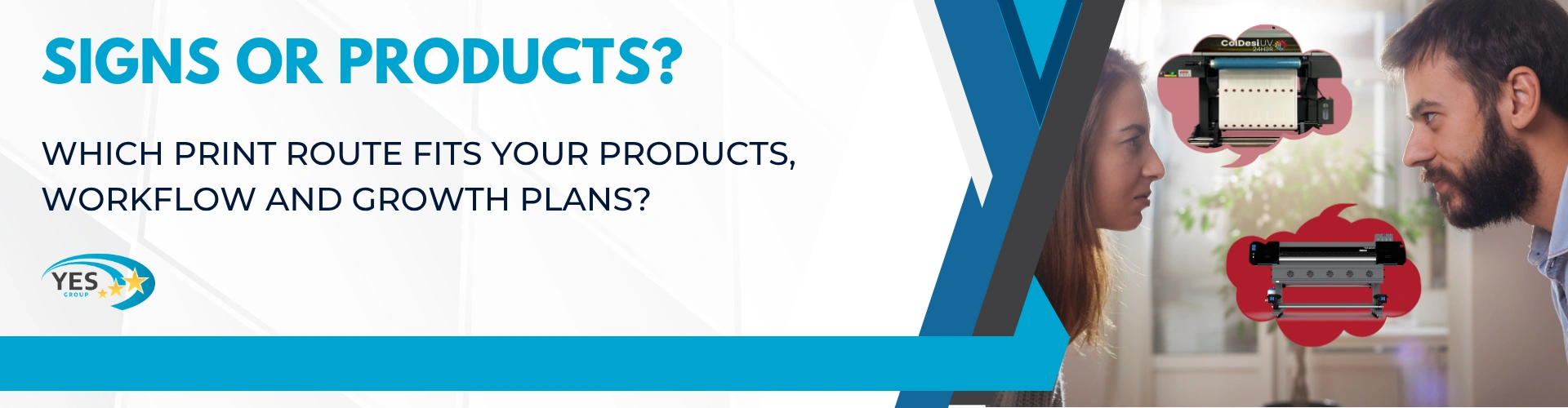
UV vs eco solvent is one of the first choices many print businesses face. At first glance, both technologies look impressive. However, they do very different jobs.
Eco-solvent suits flexible graphics such as banners, vinyl, and window visuals. By contrast, UV suits rigid items and direct-to-object work such as acrylic, wood and glass.
That is why the best question is not which printer sounds better instead the real question is what you want to make every day, how fast you need it, and where you want your business to grow.
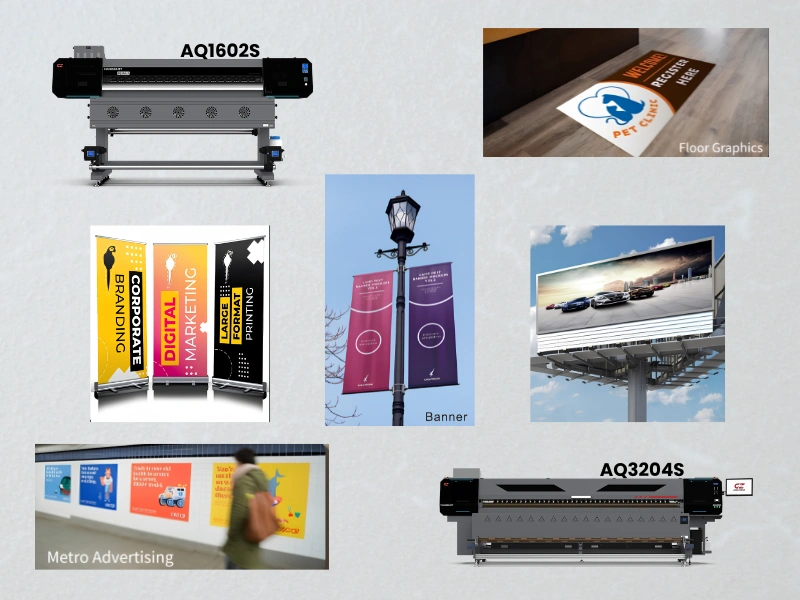
Eco-solvent printing works best on flexible roll media. In practice, it is a strong fit for banners, self-adhesive vinyl, posters, decals and display graphics.
As a result, many sign and display businesses see eco-solvent as a practical choice. It handles long graphics well and suits repeat production.
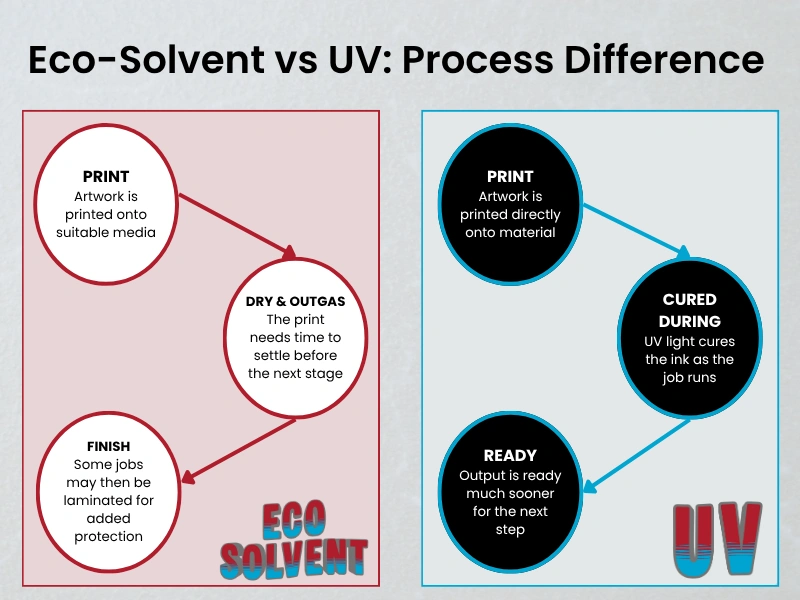
Eco-solvent also has a different finishing workflow. While prints may seem dry soon after printing, they often need more time to fully cure before the next step. Some jobs are then laminated to give extra protection, improve durability and help them last longer in use.
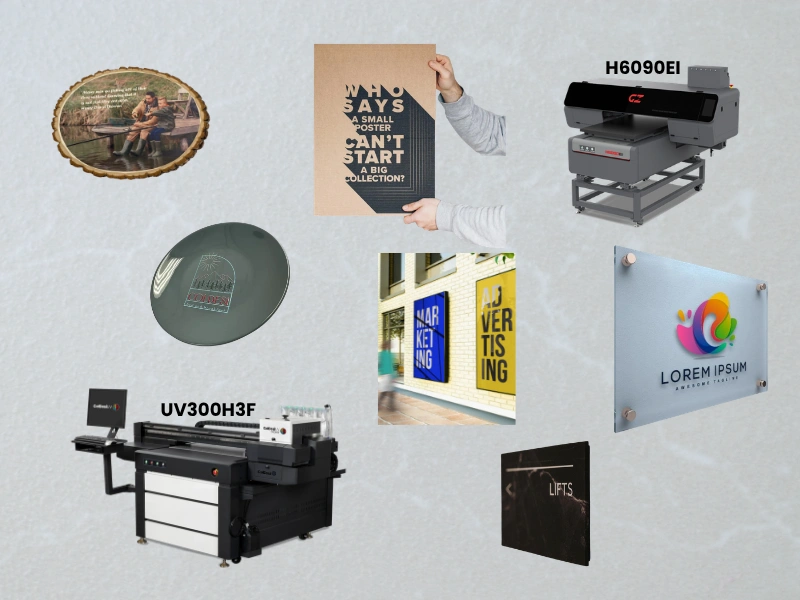
UV printing uses lamps to cure the ink as it prints. Because the ink cures during production, output is ready to handle much faster.
In addition, UV opens up a wider range of materials. You can print onto acrylic, wood, glass, metal, plastics and other rigid surfaces.
As a result, UV attracts businesses that want personalised items, short-run products and rigid signage. It also helps when you want white ink, clear varnish or textured effects.
It also helps when you want features such as white ink, clear varnish or textured effects, to allow for print onto darker or transparent materials, to add premium gloss highlights, or create finishes that feel more distinctive and higher value.
| Comparison point | Eco-solvent | UV |
|---|---|---|
| Best fit | Flexible roll media and wide-format graphics | Rigid, shaped and mixed-surface products |
| Typical jobs | Banners, posters, decals, window graphics and wraps | Acrylic signs, wood, glass, metal, gift products and drinkware |
| Print workflow | Print, dry or outgas, then finish where needed | Print and cure during production |
| Durability route | Strong outdoor graphics, often improved with lamination | Durable direct print with fast handling |
| Strength | Efficient signage and graphic output | Versatility and direct-to-object printing |
| Business feel | Signage, display and graphics focused | Personalisation, direct-to-object and rigid print focused |
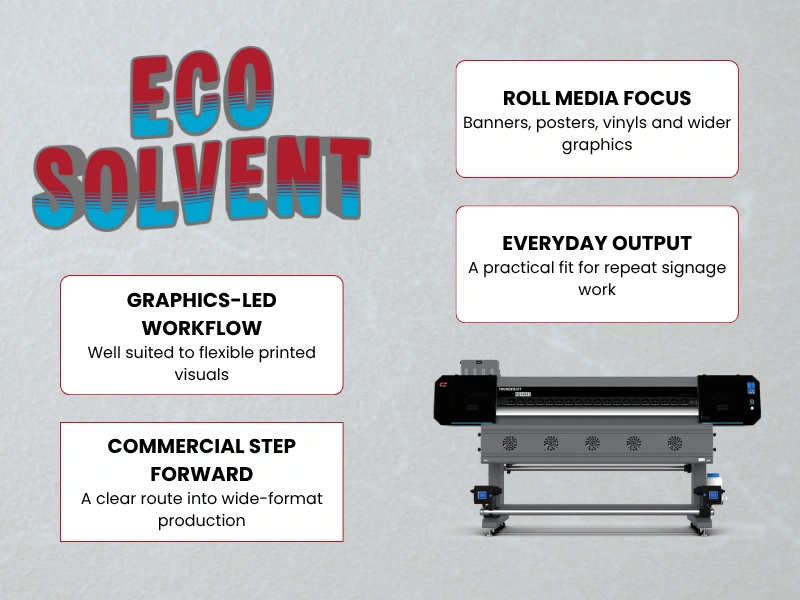
In a UV vs eco solvent comparison, eco-solvent still wins for many everyday graphics jobs.
Think banners, posters, vehicle graphics, window visuals and other vinyl-based work. It also supports efficient roll-to-roll production, which suits businesses that want to bring more signage in-house.
Just as importantly, many print businesses already know this media, lamination and finishing workflow. So, if your order book centres on flexible graphics, eco-solvent often gives the clearest commercial route.
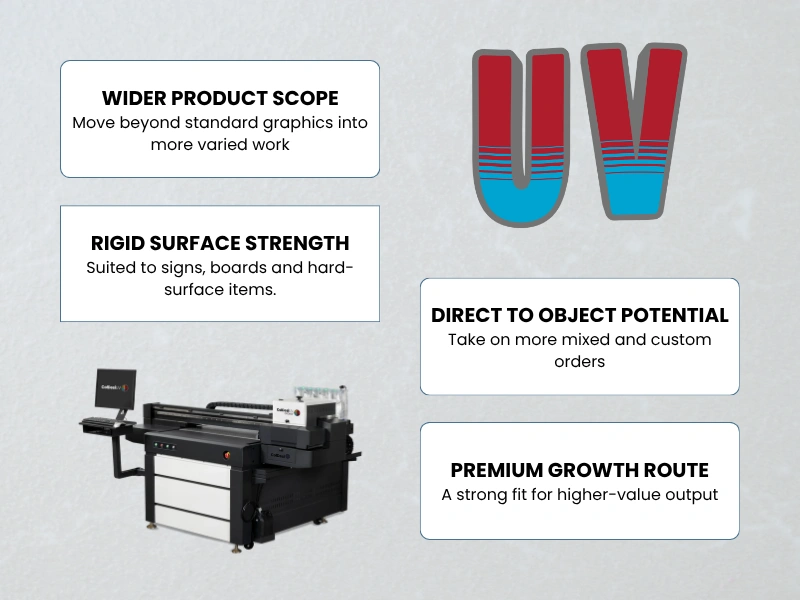
UV stands out when the goal is not just to print graphics, but to expand what your business can actually sell. It opens the door to rigid signage, branded products and premium personalised items that sit beyond the reach of many standard roll-media workflows.
That wider scope is a big commercial advantage. UV can support work across acrylic, PVC, wood, metal and other hard surfaces, making it a strong option for businesses that want to diversify into more product-led work.
It also suits short-run, custom and mixed-order jobs, where flexibility matters just as much as print quality. For businesses looking to broaden their offer and create higher-value output, UV often becomes a very practical next step.
When people compare UV and eco-solvent, durability is often treated as if there is one simple winner.
In reality the better choice depends on the material, the end use, and the finish that the job requires.
Eco-solvent has a strong reputation for flexible outdoor graphics such as banners, vinyl and window visuals. With the right media, it delivers dependable results, and jobs can then be laminated for extra protection, scratch resistance and longevity.
UV, however, takes a different route. The ink cures during printing, so the output is ready to handle much sooner. On rigid materials, that direct-print approach can streamline production and avoid the need for an added vinyl stage on certain jobs.
That is why eco-solvent often feels like the more natural fit for flexible graphics, while UV often feels like the more natural fit for direct printing onto rigid surfaces and products.
The word eco in eco-solvent can be misleading if it is taken to mean completely harmless or impact-free. In practice, eco-solvent inks are generally milder than other full-solvent systems, which is why they are often seen as a more user-friendly option. However, that does not mean they behave in the same way as water-based systems or that no chemical release takes place during production.
Eco-solvent inks still contain solvents, and during printing and drying they can release VOCs, or volatile organic compounds. In simple terms, these are gases that are given off as the ink settles and cures. That is also why eco-solvent workflows often include an outgassing period before certain finishing steps, especially where lamination is needed for protection or long-term use.
UV works differently. Instead of drying in the traditional sense, the ink is cured by UV light during printing. That means the print is ready to handle much sooner and does not go through the same outgassing stage as eco-solvent output. For many businesses, this can make production feel faster and more direct, especially on rigid materials and product-led work.
That said, neither route should be reduced to a simple “better” or “greener” label. Both still need the right setup, good ventilation, and an area that suits the materials and products being produced. In commercial terms, the real difference is not just the ink itself, but how each process fits the work you want to do every day.
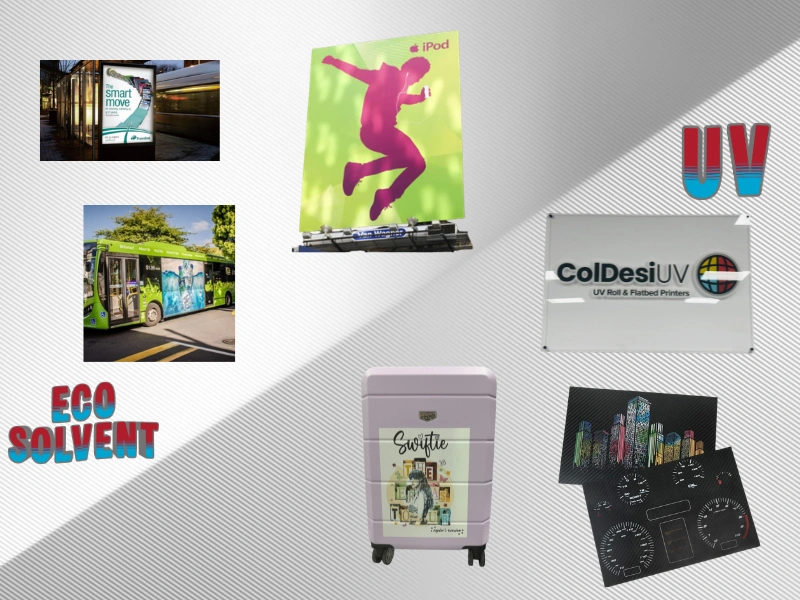
In summary, eco-solvent and UV are built for different kinds of work, so the better option depends on what you want to produce most often and where you want the business to grow. Eco-solvent is generally the stronger fit for flexible graphics and roll-fed output, while UV is often the better choice for rigid materials, direct-to-object printing and broader product customisation.
If your core work is banners, vinyl, posters, window graphics and similar signage applications, eco-solvent usually makes the most commercial sense. The GZ ThunderJet AQ Series is the natural route for that kind of production, as it is designed for wide-format graphics and signage work.
If you want to expand into acrylic signage, rigid boards, promotional products and premium personalised items, UV is usually the stronger route. The GZ A3HD suits compact direct-to-object work, with the GZ H6090EI being a practical broader step into production. If you are wanting something that is larger and production ready as well as being a flatbed then the ColDesi UV300H3F is going to be the best choice.
Ultimately, this is not about one process being better in every situation. It is about choosing the print route that best matches your everyday jobs, your preferred workflow and the kind of products you want to sell more of in future.
If you are unsure which route will be best, YES Group can help you compare the right options for the products you want to sell. They can talk you through materials, finishing, space, budget and future plans, as well as print spec to ensure the right choice is made first time.
To discuss the right setup for your business, call 01623 863343 or email sales@yesltd.co.uk