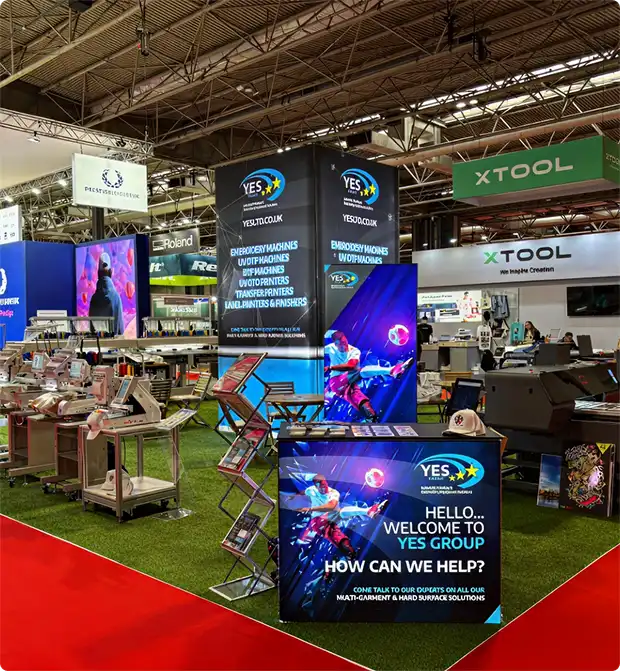
Before the doors opened, we knew exactly what we wanted our stand to do. We wanted it to feel energetic, practical and genuinely useful to the people walking onto it. Looking back after three busy days at Printwear & Promotion LIVE! 2026, that is exactly what the show became for us.
We had a World Cup 26 theme running through the stand, which gave everything a strong visual and helped bring a bit of energy to the space. But beyond the theme, the real focus was always production. We wanted visitors to see what embroidery, DTF, UV and finishing technology actually look like in action when they are set up to support real businesses, real workloads and real growth plans.The World Cup is coming, and our industry can use that with personalised shirts, team hoodies, qualifying totes and more.
What stood out most across the weekend was how practical the conversations were. People were not just asking what a machine could do in theory. They wanted to talk about turnaround, product range, workflow, support, training, output and what kind of investment makes sense at the stage their business is at right now. That made the whole show feel grounded in the right way, and we were able to show real-life examples because this is what we do and know.
One of the best parts of the show was the range of people stopping to talk. Some visitors were looking at their first serious machine investment. Others were already producing every day and wanted to improve output, tighten up a process, or expand into a new area without taking on unnecessary complexity.
That mix matters, because it reflects the market as it really is. Businesses do not all grow in the same way, and they do not all need the same answer at the same time. The conversations that stayed with us were the ones where people were looking beyond headline features and focusing on what would genuinely help them move forward with more confidence.
For some, that meant finding a more professional route into embroidery. For others, it meant faster DTF output, a cleaner finishing workflow, or a way to add UV capability without stretching too far, too quickly. Across all of it, the bigger theme was growth with purpose, not growth for the sake of it.
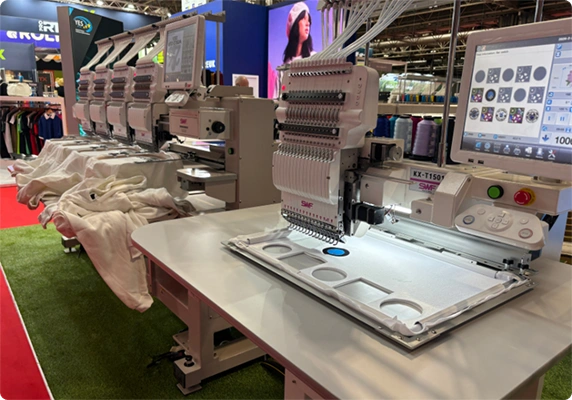
There is something about seeing embroidery happen live that still pulls people in. It is one thing to talk about stitch quality, speed or control. It is another to watch a machine working in front of you and see the finish, the movement and the consistency for yourself.
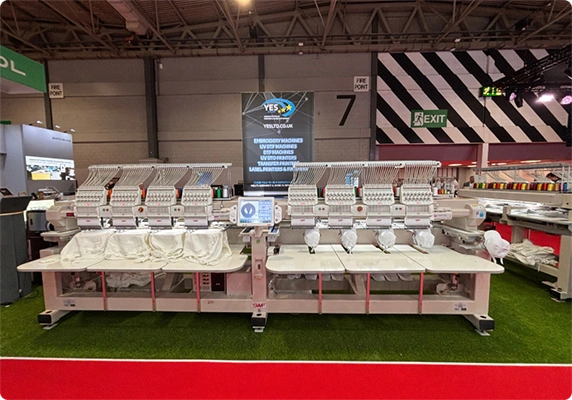
That is exactly why embroidery remained such a strong part of the stand. We had visitors who were looking at embroidery for the first time and visitors who already knew the industry well but wanted to consider their next step more carefully. In both cases, seeing production live made the conversation easier. It moved the discussion away from vague ideas and towards practical questions about what kind of setup fits the work they want to take on.
For growing businesses, that often comes down to flexibility versus throughput. A strong single-head setup can make a lot of sense when you need custom work, sampling and controlled growth. Equally, once repeat orders start building, the conversation quickly turns to multi-head machines that will keep quality high while helping output rise.
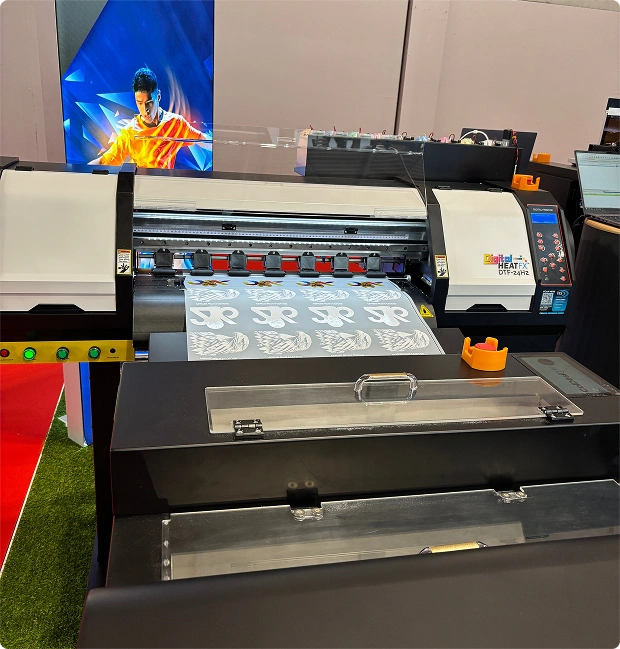
DTF printers drew a lot of attention for one clear reason: people could immediately see how it fits into a modern garment decoration workflow. Once gang sheets are moving, transfers are stacking up, and the process starts to feel repeatable, the conversation quickly shifts from curiosity to practicality.
What came up again and again for us was not just print quality. It was speed, handling, job flexibility and how easy the workflow feels day to day. Visitors wanted to know how quickly they could move from artwork to usable transfers, how the setup would fit around the work they already do, and what kind of support sits behind the printer once it is installed.
That is why DTF was such an important part of the stand story. It speaks to businesses that want vibrant, sellable transfers, but it also speaks to businesses that want a production method that can keep pace when demand picks up. When people can see that process running live, it becomes much easier for them to picture it inside their own business.
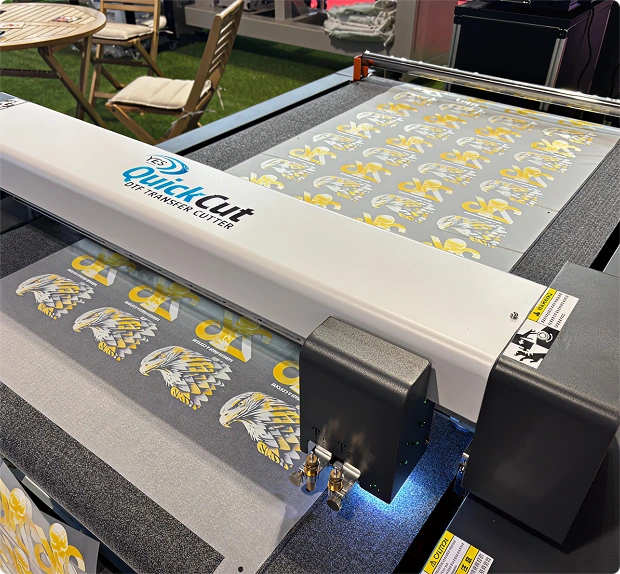
One of the most useful things about the show was that it gave us space to talk about the wider workflow, not just the printer at the start of it. That is where finishing came into its own.
For a lot of shops, the weak point is not always the print itself. It can be what happens afterwards. Manual handling, cutting time, and the small repetitive stages between print and application can all chip away at efficiency. When visitors saw finishing as part of the same production conversation, it helped reframe what a smoother setup can actually look like.
That made the YES Quick Cut side of the stand especially valuable. It helped show that workflow improvements are not only about buying a faster printer. Sometimes the real gain comes from connecting the steps around it more effectively and taking some of the repetition out of the process.
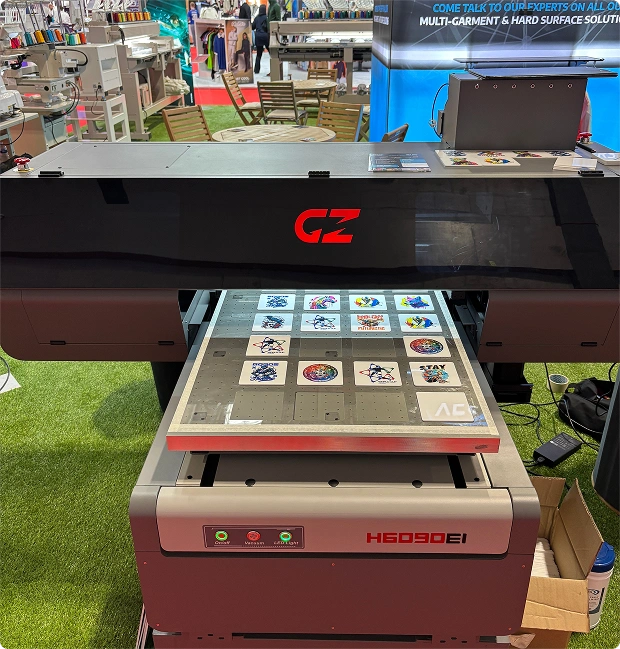
UV printing was another area where people could instantly see the wider commercial potential. Once finished, samples are on the stand, and the printer is running live, the appeal becomes much more tangible. Suddenly, the conversation is not just about print technology. It is about the types of products a business could start offering, the substrates they could work with, and the extra opportunities that come with that.
That matters because diversification is often easiest to understand when it is visible. Promotional items, signage, hard-surface decoration and other rigid-product work all start to feel more realistic when visitors can see the print quality up close and connect it to jobs they already get asked about.
For businesses already in the DTF workflow, UV is so appealing. You already have the logo, the artwork, the slogan. You are providing high quality prints with great margins… and now you can offer matching merch. Add a water bottle, a notebook, keep it simple with a pen or think bigger because a 60 x 90 flatbed offers you a lot of space to get creative.
For us, that made UV one of the most commercially interesting parts of the stand. It showed how a business can build beyond garments alone and start thinking more broadly about customisation, product range and margin. It also helped open up conversations with visitors who may not have arrived expecting UV to be relevant to them, but quickly started seeing where it could fit.
If there was one theme that connected nearly every meaningful conversation we had, it was support. People care about the machine itself, but once they are seriously considering an investment, they quickly want to know what happens after the sale.

That is where installation, training, technical guidance and after-sales support stop being side topics and become a major part of the decision. Businesses want to know that the machine will be set up properly, that their team will understand how to use it, and that there is a clear route to help if they need it later.
That was one of the strongest messages running through not just the stand but the whole YES team. Good equipment matters, but long-term confidence matters just as much. For businesses planning to grow, that combination of machinery, advice and support is often what turns a good fit into the right fit.
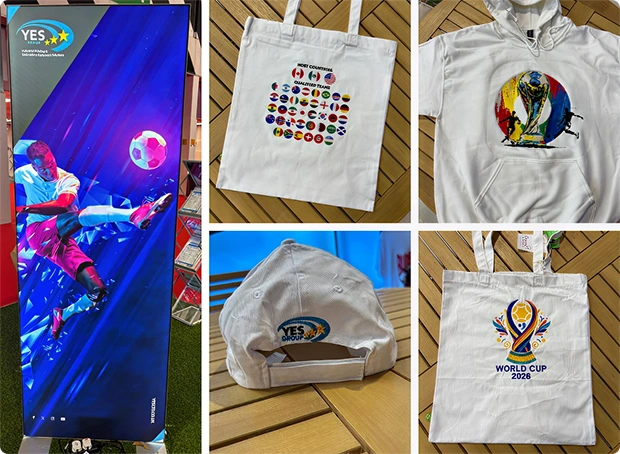
By the end of the show, the most important outcome for us was not simply that people had seen a machine run. It was that they left with a clearer picture of what their next step could look like.
Sometimes that means recognising that a business is ready to move into embroidery with more confidence. Sometimes it means improving a DTF workflow that is already working but could be smoother. And other times it means adding UV capability or a wider product offer to support a broader growth plan. The best conversations were the ones where the technology connected directly to a real business need.
That is what we always want the stand to do. Not just impress people for a few minutes, but help them think more clearly about what will make a genuine difference once they are back in their own workspace.
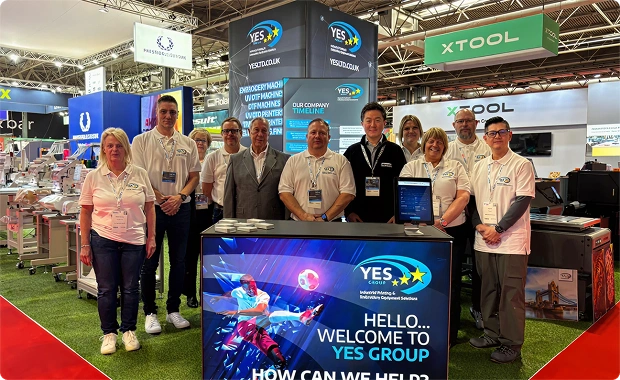
Printwear & Promotion LIVE! 2026 may be over, but the conversations it started are still the important part. A good show doesn’t end when the stand comes down. It helps people move forward with a better understanding of what they need, what they want to improve, and what kind of setup is going to support that growth properly.
Now you know what your next step in embroidery, printing or finishing is and need to discuss which machine is best suited to those growth plans, it is the perfect time to call our expert team on 01623 863343 or email sales@yesltd.co.uk.