Attention: Our phone systems are currently down. We apologize for any inconvenience this may cause.
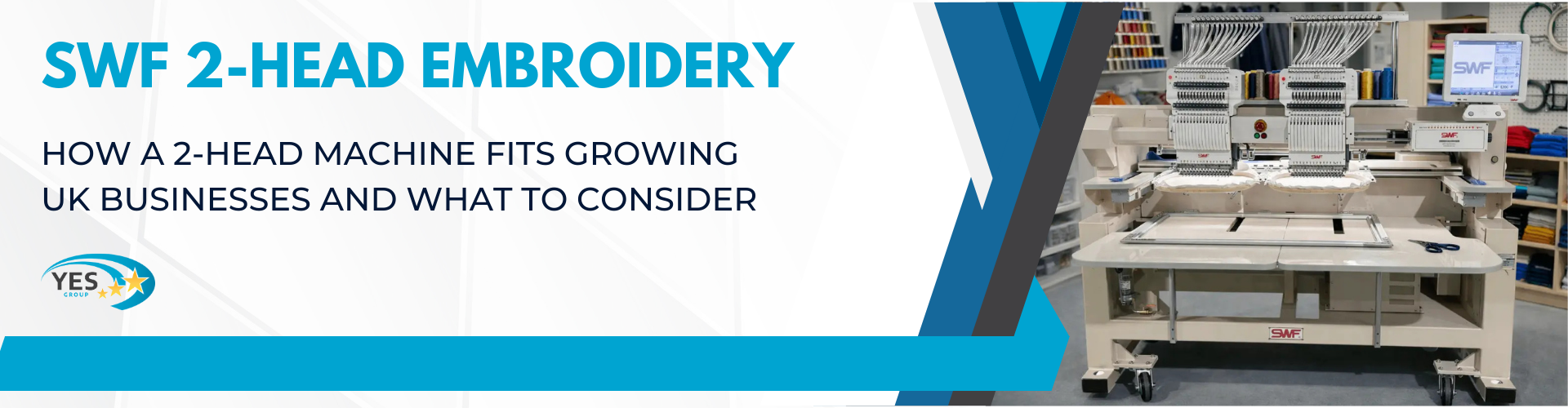
2 head embroidery machine graphic

SWF 2-Head Embroidery Machines: Who They're Built For in the UK

SWF 2-head embroidery machines are designed for UK businesses that need more output and consistency than a single-head setup can provide, without committing to the scale, footprint, or operational complexity of larger multi-head systems. They are used both by established embroidery shops upgrading from single-head production and by businesses choosing to start with a multi-head configuration from day one. This category is particularly relevant for print businesses adding embroidery, workwear suppliers bringing production in-house, and new embroidery operations with clear expectations around repeat orders. A 2-head machine offers a practical balance of throughput, control, and space efficiency, allowing structured production runs to be handled within the constraints of small to medium-sized UK workshops. Rather than representing a universal “next step,” 2-head machines sit at a specific point in the production landscape. Understanding who they are built for, and who they are not, helps buyers decide whether this configuration aligns with their workload, job mix, and growth plans.

How UK Businesses End Up Choosing a 2-Head Machine

SWF 1502 and 1501 2 head embroidery machines side by side

UK buyers typically arrive at a 2-head machine through one of two paths: starting directly with a multi-head setup or upgrading from an existing single-head workflow. In both cases, the decision is driven less by experience level and more by production requirements.

When evaluating this category, buyers commonly compare 2-head machines against high-spec single-head options and entry-level 4-head models. Key considerations include output per operator, ease of maintenance, control interface familiarity, compatibility with existing digitising workflows, and access to UK-based technical support. Practical factors such as hoop sizes, stitch speeds, design memory, and overall machine footprint also play a role, particularly for businesses operating from shared units or home-adapted premises. Shortlisting often includes established brands such as SWF, Tajima, and Happy.

Starting with a 2-Head Machine

Many UK businesses choose to start with a 2-head embroidery machine rather than purchasing a single-head first. This approach is common among print shops expanding into embroidery, workwear suppliers launching in-house production, and new ventures with a clear expectation of repeat orders from the outset.

Starting with two heads reduces early upgrade pressure and avoids the disruption of changing workflows shortly after launch. It allows small batch runs to be completed more efficiently from day one while maintaining consistency across garments.

Compared with running two separate single-head machines, a 2-head setup often offers simpler operator management, a more compact footprint, and better consistency for repeat logos.

Cost considerations also play a role. The per-head cost of embroidery machines typically decreases as head count increases, making a 2-head machine more cost-effective than purchasing two separate single-head units when the business model centres on uniforms, teamwear, or standardised branding.

Upgrading from a Single-Head Setup

For existing embroidery businesses, upgrading to a 2-head machine is usually driven by throughput constraints rather than stitch quality. In practice, most businesses do not sell or trade in their single-head machines when growing. Instead, they add a 2-head unit to increase capacity.

Growing order sizes, repeat work that monopolises a single machine, and pressure to shorten turnaround times often expose bottlenecks caused by hooping time, colour changes, and repeated setups. In these situations, a 2-head machine allows identical garments to be run simultaneously under a single operator, significantly increasing output without doubling staffing or floor space.

While adding a second single-head machine offers flexibility for mixed designs, a 2-head machine is often preferred when the workload consists primarily of repeat jobs where consistency and speed matter more than running multiple different designs at once.

Where This Category Fits in Real Production Workflows

In real UK production settings, 2-head embroidery machines are most commonly used to handle medium-volume jobs such as schoolwear, workwear contracts, and personalised garments for ecommerce brands. They enable mirrored or sequential stitching of the same design, effectively increasing daily output while maintaining control over placement and stitch quality.

These machines are typically operated by a single person and may serve as the primary production unit in a small workshop or as an expansion alongside an existing single-head setup. They are not usually networked into large automated production lines but are often positioned near heat presses, folding stations, or packing areas in hybrid print and embroidery operations.

Common Buying Mistakes

A common mistake UK buyers make is assuming that doubling the number of heads will automatically halve production time. In reality, efficiency gains depend on operator workflow, garment loading and unloading speed, and whether both heads can be kept running consistently.

Another frequent issue is underestimating space requirements. While smaller than 4-head and larger industrial machines, 2-head units still require more clearance than a single-head setup. Some buyers also invest too early, before they have consistent order volumes to justify the machine’s footprint and maintenance demands. Overlooking the availability of local support or training can result in underutilised capacity or prolonged downtime.

UK-Specific Considerations

Space remains a critical factor in UK workshops, many of which operate from converted retail units or small industrial premises. A 2-head machine typically requires roughly double the footprint of a single-head unit, plus additional clearance for operator access and maintenance.

Power requirements are usually met via standard single-phase UK mains supply, making 2-head machines viable for businesses without access to industrial three-phase connections. Most units are run by a single operator, so ease of use, intuitive controls, and efficient setup processes are important.

Buyers should confirm the availability of UK-based technical support, training, and spare parts. SWF machines supplied by YES Group include a 5-year warranty and a 7-year stitch quality guarantee, both subject to conditions including regular servicing. YES Group provides installation, training, and ongoing support across England, Scotland, Wales, and Northern Ireland.

Category or Configuration Breakdown 

SWF’s 2-head embroidery machines are generally configured for flatbed and cap embroidery, with automatic colour change and standard hoop sets. Models may vary by maximum stitch speed, onboard design memory, and control panel interface. These machines are typically standalone units rather than modular systems, with basic networking capability via USB or LAN. Optional accessories may include extended tables, additional cap frames, or hooping stations to support production efficiency.

Notable Differentiators

SWF 1502D 2 head embroidery machine

SWF 2-head embroidery machines are often recognised for their user-friendly control interfaces and relatively compact footprint compared with similar configurations from other brands. Features such as thread break detection, tension monitoring, and reliable drive systems can reduce operator intervention during longer runs.

One configuration worth noting is the availability of dual function technology in the 2-head category. Unlike standard 2-head machines where both heads must run the same design, dual function models allow each head to run a different design independently. This can be useful for businesses handling mixed orders, small batch personalisation, or simultaneous cap and garment work. Dual function also means that if one head stops for a thread break or maintenance, the other continues running.

The SWF KX-T1502D is an example of a dual function 2-head machine available in the UK, featuring 15 needles per head, Wi-Fi connectivity, and smart tension and presser foot systems.

FAQs 

Internal Navigation and Next Steps

To explore specifications and available configurations, review the SWF single-head and 2-head embroidery machine category:
https://www.yesltd.co.uk/industrial-embroidery-machines/swf-single-head-embroidery-machines

Buyers interested in dual function technology can view the SWF KX-T1502D:
https://www.yesltd.co.uk/industrial-embroidery-machines/swf-embroidery-machines/swf-kx-t1502d-dual-head-embroidery-machine

For higher-volume requirements, the 4-head category provides additional context:
https://www.yesltd.co.uk/industrial-embroidery-machines/swf-4-head-embroidery-machines

For a broader overview of how to choose the right SWF machine, see the complete guide:
https://www.yesltd.co.uk/industrial-embroidery-machines/swf-embroidery-machines